

Moneyball 2.0
The AI Revolution in Sports and Business
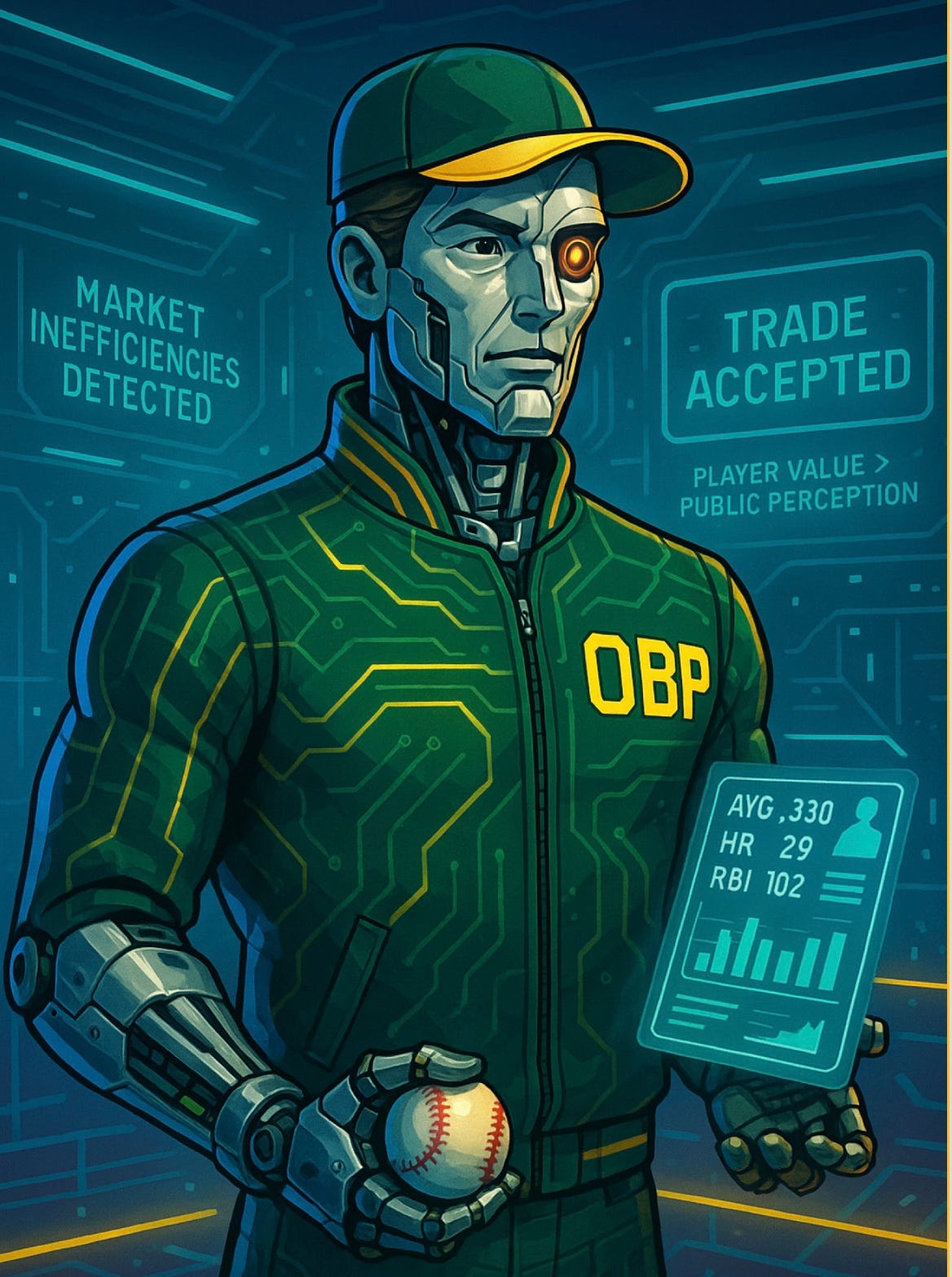
Remember Moneyball? The story of the Oakland A's, a team with one of the lowest budgets in the league, who used data and statistics to challenge conventional wisdom and build a winning team. That was Moneyball 1.0, and its core lesson extended far beyond baseball: it was about rethinking value and finding it where others simply weren't looking.
But the game has changed, and so has Moneyball. We're now entering the era of Moneyball 2.0, where the power of Artificial Intelligence (AI) is transforming decision-making in sports and business, moving us from merely informing decisions with data to having AI make and adapt those decisions at speed.
Moneyball 1.0 was about using data to analyse past performance and inform future choices. It was descriptive, looking back to understand "what actually matters in winning games?". This led to significant shifts in how sports teams approached strategy, as seen in the changing shot locations in the NBA or advanced football metrics like xG. The ripple effect extended to business, with the rise of analytics challenging gut instinct across industries.
Moneyball 2.0, however, represents a fundamental shift with three core tenets:
From Hindsight to Foresight: No longer content with just understanding what happened, Moneyball 2.0 is about predictive analytics. AI models forecast outcomes and identify future opportunities, moving beyond descriptive analysis to anticipating what's next.
From Static to Adaptive: Traditional models are often static, requiring manual updates. Moneyball 2.0 introduces adaptive models that update in real-time. This means insights are constantly refreshed, allowing for immediate adjustments to strategy as conditions evolve.
From Augmentation to Automation: Perhaps the most significant shift is the move towards automation. In some scenarios, AI systems are now making decisions autonomously, with no human intervention required. This accelerates decision-making to unprecedented speeds.
This isn't just theory; it's already being implemented. Take Sevilla FC, for example. Their Chief Data Officer, Elías Zamora, noted that while their in-house tools excelled with structured data, they struggled with unstructured data like human scouting reports – a crucial element for comprehensive player evaluations. By leveraging Large Language Models, Sevilla FC can now process vast amounts of unstructured data, allowing their Sporting Director, Victor Orta, to get all the necessary information to make a decision in "perhaps two minutes," rather than the time it took to manually review 45 scouting reports.
Similarly in the business world, the BMW Group introduced a central AI access point for their Purchasing and Supplier Network in late 2024: the BMW Group’s AIconic agent system. This AIconic Tender Assistant empowers procurement teams by:
Selecting the right templates and generating free-text content.
Incorporating the latest and best practices from previous tenders.
Checking adherence to quality standards throughout the tendering process.
Helping determine if suppliers meet specific departmental requirements.
Markus Kronen, Head of GenAI in Purchasing and Supplier Network at BMW Group, highlights that AIconic significantly boosts employee efficiency and productivity, setting new benchmarks for AI utilisation.
The implications of Moneyball 2.0 for strategy are profound. AI is not merely a tool; it fundamentally alters how value is created. This shift also redefines leadership, moving from traditional "decision-makers" to "decision architects" who design and oversee AI-driven processes. It also means a change in who organisation’s hire and how teams are built.
However, this exciting evolution isn't without its challenges. The increased reliance on AI comes with inherent risks, including the potential for decisions to become opaque leading to a loss of explainability, and maybe more importantly, accountability. As we embrace Moneyball 2.0, addressing these governance issues will be paramount.
Ultimately, the essence of Moneyball 2.0 can be distilled into a powerful truth: "Those who learn faster than their competition win". In an age where AI can make and adapt decisions at incredible speed, the ability to rapidly learn and iterate will be the ultimate competitive advantage.
In the future, the next Billy Bean might be a "Billy Bot". Organisations that embrace this shift to AI-driven decision-making and value creation will gain a significant competitive advantage, empowering them to defy expectations and achieve success against the odds.
Shifting to foresight modeling, adaptive usage, and automated processes indeed shows a huge potential! Recently, the paper https://arxiv.org/abs/2502.07528 showed the potential of foresight modeling. Would be of great added value if implemented automatically and used adaptively!